Hollywood
I'd Like to Apologize to Every Teacher I Ever HadHollywood is less a physical setting than the powerful career world Tony Danza carries with him into the classroom. It signifies television, acting, money, public performance, and a ready-made identity, but also the safety net he must surrender before teaching can become real. The book’s movement away from Hollywood is therefore a movement from performed authority toward earned responsibility.
Career and Departure
Hollywood’s pull is established through Tony’s earlier life in entertainment. After earning a history degree and originally planning to teach, he was rerouted first into boxing and then into acting; even his television character on Who’s the Boss? eventually became a teacher. His work on The Tony Danza Show allowed him to combine celebrity with public service through “School Room Makeovers,” including a music-room renovation for a school that had only six instruments for four hundred children. Yet the show’s cancellation, followed by his separation from his wife after twenty years of marriage and the increasing distance from his three children, forced him to reconsider what remained of his professional and personal life.
Age sharpens the departure. Tony notes that he is approaching sixty, while his father lived only to sixty-two, and begins to feel that time may be running out. The realization sends him back toward the vocational dream abandoned after college: teaching in an actual school rather than portraying a teacher on television. Hollywood had given him visibility and influence, but it could not provide the same kind of contribution he hoped to make in a classroom.
Hollywood and the Television Experiment
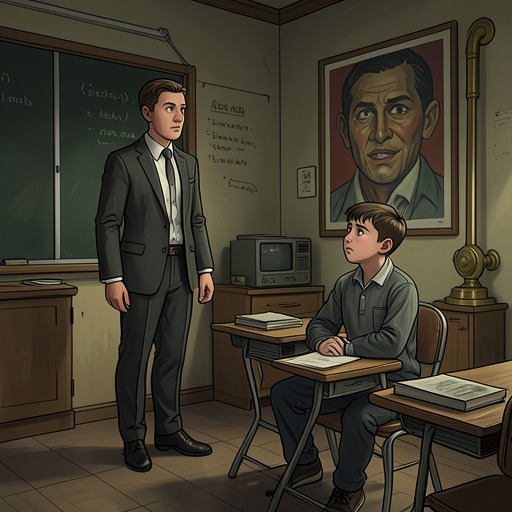
Hollywood does not disappear when Tony enters Northeast High School; it follows him in the form of cameras, producers, network expectations, and the possibility of turning teaching into a reality show. Tony initially rejects that idea because he wants to teach rather than combine teaching with show business. He fears that a program built around real students would place dramatic “sizzle” above their education and could compromise or exploit them. His stated principle is that the students must come first, with the cameras observing what actually happens rather than scripting conflict in advance.
The production’s logic repeatedly clashes with the educational purpose Tony is trying to establish. After a successful Washington, D.C. field trip in which the students were engaged and learning, Leslie Grief calls to complain that the footage contains no drama. The ordinary success of the trip is treated as unusable television because nothing sensational happened. Tony’s response exposes the central conflict: what is good teaching may look uneventful to entertainment executives, while the manufactured or heightened conflict sought by television may be precisely what students do not need.
The Classroom Against the Safety Net
The contrast becomes most direct when Leslie warns that the network may cancel the show. Tony’s first reaction is relief. He is tired of being miked, filmed, and forced into production battles, and he has become convinced that the kind of drama the network wants is incompatible with the work his students need. Hollywood’s demands make him feel that teaching is constantly being judged as material rather than lived as an obligation.
But the possible cancellation also threatens his income. Without the production, he will continue teaching his class as a volunteer, despite recognizing it as the most difficult job he has ever undertaken. That financial vulnerability connects his experience with the millions of teachers who must perform demanding professional work without the security or compensation associated with celebrity employment. Hollywood’s disappearance thus becomes a test of commitment: once its paycheck and protective distance are removed, Tony has to decide whether the teacher identity can stand on its own.
After the first-semester screening, Tony returns to his apartment and looks out through the “magic window,” thinking about his temper, his home in Los Angeles, and the life he has left behind. He briefly considers quitting and returning to the familiar world. The thought collapses almost immediately, however. Leaving is no longer an acceptable conclusion to the experiment; despite the uncertainty, he decides that he is a teacher for the duration.
Hollywood as Contrast and Memory
Hollywood remains present in the way Tony measures classroom experiences. At Northeast’s teacher talent show, seven hundred students watch their teachers perform, and Tony thinks the response surpasses that of any show he has played in Hollywood. The comparison does not simply celebrate the school audience. It reverses the usual hierarchy of prestige: the applause of students for teachers becomes more meaningful than the professional reception of a Hollywood performance because it arises from a shared school community rather than from the entertainment marketplace.
The talent show also lets Tony use theatrical experience without surrendering control of the event to television. He organizes it independently, gives teachers a chance to display hidden talents, and directs the proceeds to the band, choir, and school newspaper. When a musical glitch threatens to stall the program, he plays “Umbrella” on the ukulele while Nakiya holds the microphone, turning an interruption into collective participation. The scene demonstrates a different use of performance: not the manufacture of drama for viewers, but a practical resource for sustaining a community.
Lasting Significance
Hollywood’s decisive narrative function is to define what Tony must unlearn and what he cannot entirely abandon. It supplies confidence, theatrical skill, connections, and a vocabulary of performance that help him reach students and teachers. It also encourages the belief that conflict must be visible to matter, a belief challenged by the quiet work of instruction, care, and persistence.
By the end of the school year, Tony’s decision to return home is motivated partly by the need to work on being a husband and father and partly by the admission that teaching is extraordinarily hard. His departure from Hollywood is therefore not a simple rejection of entertainment, nor does it erase his former identity. Instead, Hollywood becomes the background against which his new professional seriousness is measured: the place of paid performance and public image remains behind him, while the classroom demands a form of work whose value cannot depend on ratings, applause, or a safety net.